















By John Vincent Gordon, Founder, Expat Choice
Truth be told, I could have driven straight past Billinudgel. Many people do.
It is there and then, almost before you have registered it, it is behind you. It's a unique left turn off M1 highway, just 10 minutes past the Byron Bay exit driving north to Gold Coast. A handful of buildings, an old pub, the café across the road, and a village carrying on with its day without appearing terribly concerned whether you stop or not.
There is something quite refreshing about that.
No grand entrance. No oversized sign instructing us that we have arrived somewhere "iconic." No queue of people waiting to photograph a breakfast they may or may not eat. Billinudgel does not reach out and grab you.
You have to notice it.
I have travelled through more than forty countries and encountered all sorts of places along the way. Some magnificent. Some are famous for good reason. Others are so determined to prove their importance that the experience becomes exhausting before you have even sat down.
I’ve eaten in Michelin-starred restaurants in Singapore, wandered down those half-forgotten Bangkok laneways that can change character within twenty meters, shared coffee with artisans in Italy, and sat under ancient olive trees in Greece.
Wonderful memories, all of them.
And yet this tiny village on the far North Coast of New South Wales caught me in a different way. There was no grand reveal. Nobody promised me the finest coffee in Australia, thank goodness, and nobody suggested that a plate of food was about to change my life.
I simply stopped.
After the rain, the whole place carried that unmistakable North Coast scent—wet ground, eucalyptus, and vegetation waking up again. A butcher bird was calling from somewhere nearby. A screen door opened and closed. Someone crossed the road. Another person called out a name.
That was the beginning of it for me.
A name.
People still seemed to know one another here.
Not in the superficial way we now “know” hundreds of people through screens, updates, and photographs, but properly. They knew who had been away, who was back, who had not been feeling well and, I suspect, who had been telling a story with a little more decoration than the truth required.
Nobody appeared to be in a hurry to finish the conversation.
It made me wonder when that became unusual.
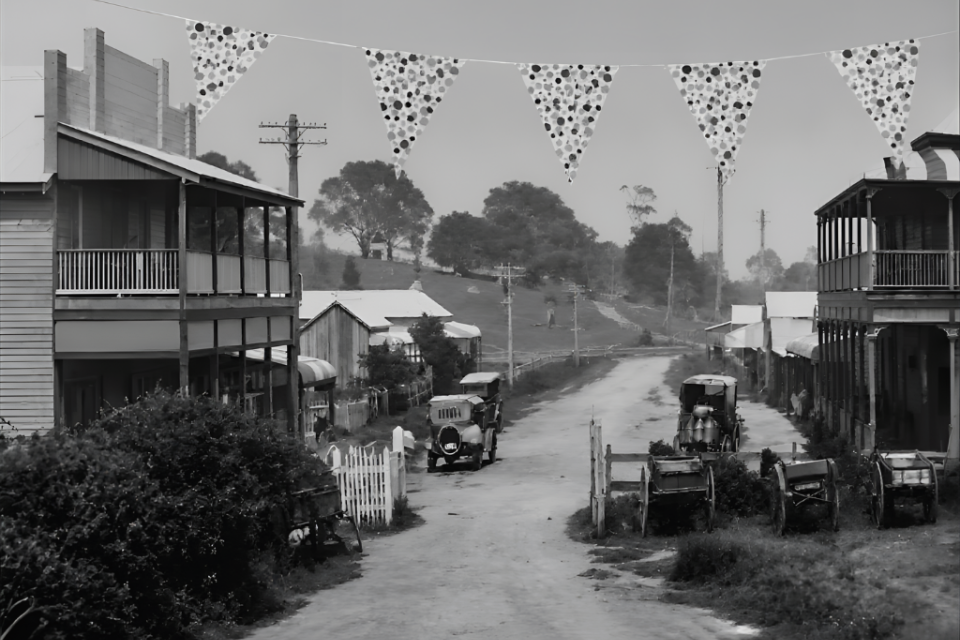
Billinudgel had not been preserved as a display of old Australia. It was not pretending to be anything. It was still being lived in, and there is an enormous difference between a village with character and one where “character” has been professionally applied.
The story, of course, began long before the buildings on Wilfred Street.
This country belongs to the Minjungbal people of the Bundjalung Nation. It always has. The coast, Brunswick River, and volcanic hinterland were part of one connected living landscape, understood through movement, seasons, food, family, and knowledge handed from one generation to the next.
European settlement brought a very different view of the land.
The great red cedars of the Big Scrub became “red gold. "That expression tells us plenty. Magnificent trees, some of them standing for centuries, were reduced in language to their commercial worth before being felled, dragged out by bullock teams, and transported towards the Brunswick River.
From there, the timber travelled to Sydney.
Then another tree came down.
And another.
What remained of the forest was progressively cleared as dairying, bananas, and farming changed the valley. Brunswick Heads developed its own relationship with fishing and the sea. Roads appeared. Settlements took shape. Families arrived, worked, struggled, stayed, or moved on.
The railway reached Billinudgel in 1894 and connected the village to markets well beyond the district. Trains carried passengers, produce, bananas, and cream cans destined for the butter factory.
Dates can make history appear very orderly.
Real life would not have been.
There must have been mud, missed trains, broken equipment, arguments over money, children underfoot, exhausted men returning home, and women holding households together while keeping farms functioning. There would have been good seasons when people dared to get ahead and dreadful ones when merely getting through was enough.
We tend to polish the past once everybody who endured it is no longer here to object.
Billinudgel’s old hotel has endured a fair bit itself.
Standing on Wilfred Street, the Billinudgel Hotel is not merely a picturesque country pub waiting to decorate someone’s weekend drive. Earlier hotels on the site were destroyed by fire. Another building rose and village life resumed because that is what people did.
The pub lived through floods, wars, depressions, the end of the railway, the highway bypass, and decades of social change. There must have been moments when its future looked anything but certain. Yet there it stands.
Its most celebrated publican was Margaret Alice “Ma” Ring, who took over the license in 1929 and remained for fifty-three years. She became known as Australia’s oldest publican, and when she turned one hundred, the celebration filled the street.
A hundred years of life. More than half a century behind the bar.
Imagine what she knew.
Actually, imagine what she knew and wisely chose never to repeat.
Country pubs have always carried more than beer. They carry news, rumors, reconciliations, wakes, weddings, bad jokes, worse singing, and the occasional disagreement that becomes more significant with every retelling.
They give people somewhere to go when home feels too quiet.
That matters in a small community.
Across the road is The Billi Café, and the shift from history to hunger happens fairly quickly once the smell of food reaches you.
There is fresh coffee, butter disappearing into hot toast, burgers on the grill, and chips wrapped in paper. There are loaves of bread, milkshakes, custard tarts, rocky road, and cakes sitting near the counter, making a fairly strong case against self-discipline.
The timber floor creaks. Locals call out to one another. People come through the door and are recognised.
I found myself lingering.
Behind the counter was Anne, who was doing much more than serving food, although I doubt she would make a grand claim about it. People arrived, and she acknowledged them. Those who had been coming for years were known, naturally, but newcomers were not treated as an interruption.
There was room for everybody without anybody needing to announce how inclusive the place was.
We started talking.
One story opened another. Dairying. Bananas. The railway. Families who had worked in the district for generations. The conversation moved backwards and forwards, as conversations do when they are not being managed into a tidy sequence for publication.
Then Anne told me about her grandfather.
He had been killed in a cedar-logging accident when a log rolled from a cart.
I stopped at that.
It was not a historical curiosity or a dramatic detail borrowed to strengthen an article. It was her family. A man had gone out to work and had not returned. Everyone who loved him then had to work out how life was supposed to continue.
The family’s relationship with the land did continue, but it changed. Parts of their property were later protected, allowing rainforest to return rather than another generation simply taking what remained.
There is no perfectly shaped moral lesson here, and there should not be.
One generation was caught up in an industry that stripped away the cedar. Another helped protect the recovering forest. Between those two facts sit necessity, grief, changing knowledge, and all the contradictions families carry.
Anne did not decorate the story. She did not need to.
Then she said something I have continued to think about:
“If we lose the locals, we’re just a façade.”
That is not tourism copy.
It is a warning.
Across Australia, beautiful towns are being polished to within an inch of their lives. Property values rise. Old houses become investment opportunities. Local shops become "concepts." Visitors arrive because they want authenticity, and then, without necessarily intending to, help create the economic conditions that drive out the very people who made the town authentic.
The buildings remain.
The soul packs a trailer and moves inland.
That may sound harsh. It is also happening.
The volunteer who helps clean up after a flood cannot remain if the rent has doubled. The family that has kept the local sporting club alive cannot participate from eighty kilometres away. A town does not lose its community in one dramatic moment. It loses it person by person.
A mechanic closes.
A teacher relocates.
A young family decides it is simply too hard.
The lights are still on, and the cafés may be busier than ever, but something has gone missing.
Anne understands that because she watches community happen from behind the counter. Billy Café sells breakfast and coffee, yes, but its real value is harder to put through the till.
A name remembered.
A person noticed.
A story passed on before the person carrying it is no longer there to tell it.
We speak endlessly now about connection, generally while looking into devices designed to distract us from whoever is sitting nearby. Billinudgel offers a simpler version. Walk through a door. Order something. Look up. Speak.
Better still, listen.
When I eventually left, I realised the food was not what would stay with me. I may remember the coffee, the cakes, and the prospect of fish and chips. I will certainly remember the pub across the road.
But the enduring memory will be how the village made me feel.
For a little while, I had entered a place where history was not sealed behind museum glass. It was standing behind a coffee machine. It was sitting at the bar. It was carried by people who remembered the railway, the farms, the floods, and the names of those who had come before.
Billinudgel does not need to become the next Byron Bay.
We already have a Byron Bay.
What Billinudgel possesses is rarer: it still appears to know what it is. Whether it can hold onto that while the region changes is another question, and not one that should be left solely to the people who have been carrying the village until now.
Visitors have responsibilities too.
So, if you find yourself passing through, stop.
Do not arrive with a checklist. Do not spend seven minutes manufacturing evidence that you were there and then race away to the next destination.
Order the fish and chips. Sit outside if the weather allows it. Cross the road and have a drink at the pub. If Anne has time to talk, let the conversation find its own direction.
You may hear something worth remembering.
And somewhere between the first sip of coffee, the creak of the timber floor, and the last chip wrapped in butcher's paper, an old-school thrill for the kids—you might notice what Billinudgel has managed to keep.
Not perfection.
Not progress packaged for visitors.
Something far more fragile.
A place where Australia still knows your name.