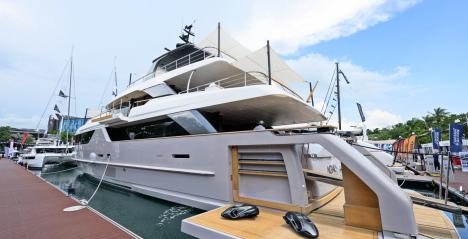













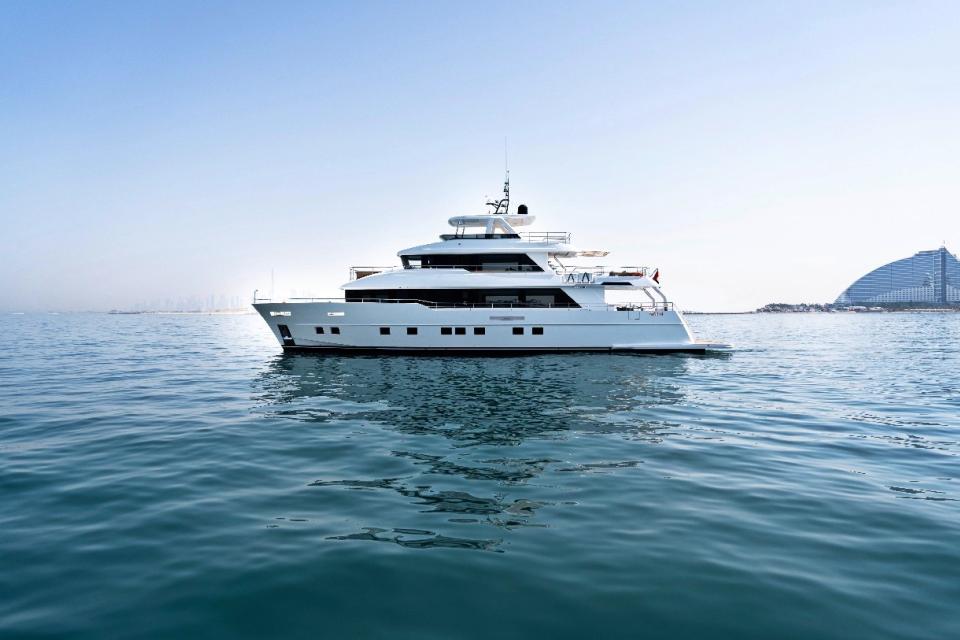
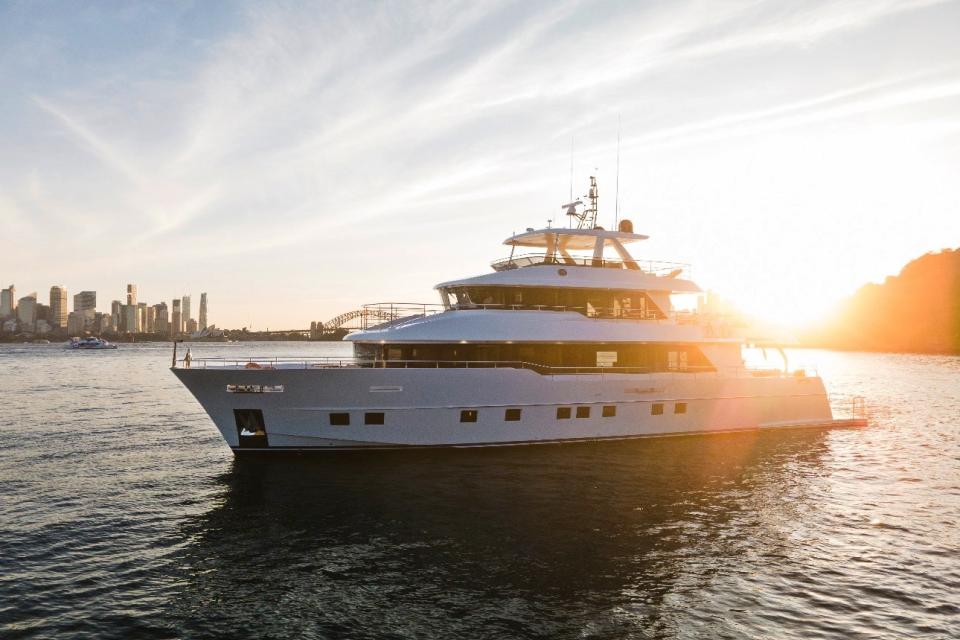
The Nomad 101 is not trying to impress you – although it has every right to. That's the first thing you notice. Thirty metres of considered engineering, five staterooms, more than 3,000 nautical miles of range – and yet it doesn't shout. The teak is warm. The light comes in generously. Everything is at human scale. It feels, oddly, like somewhere you could actually live.
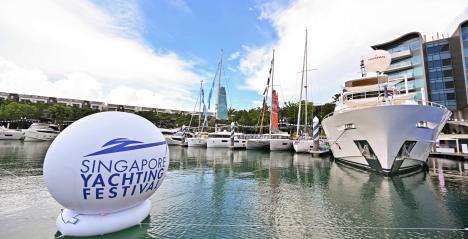
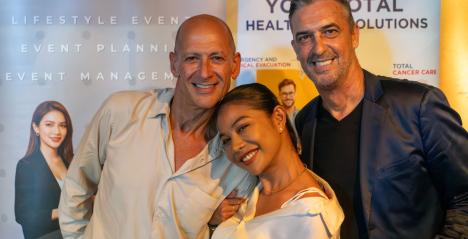
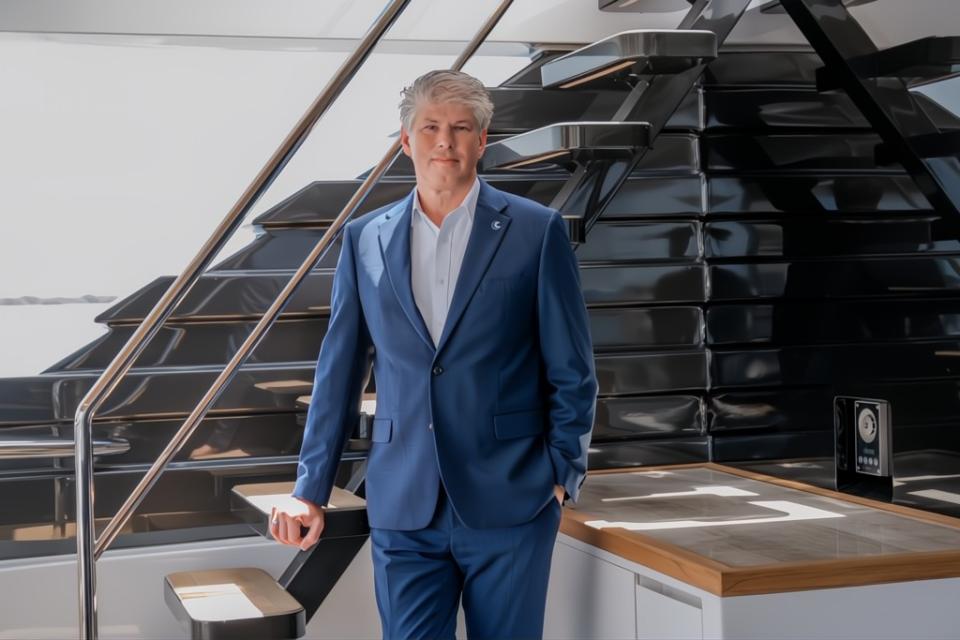
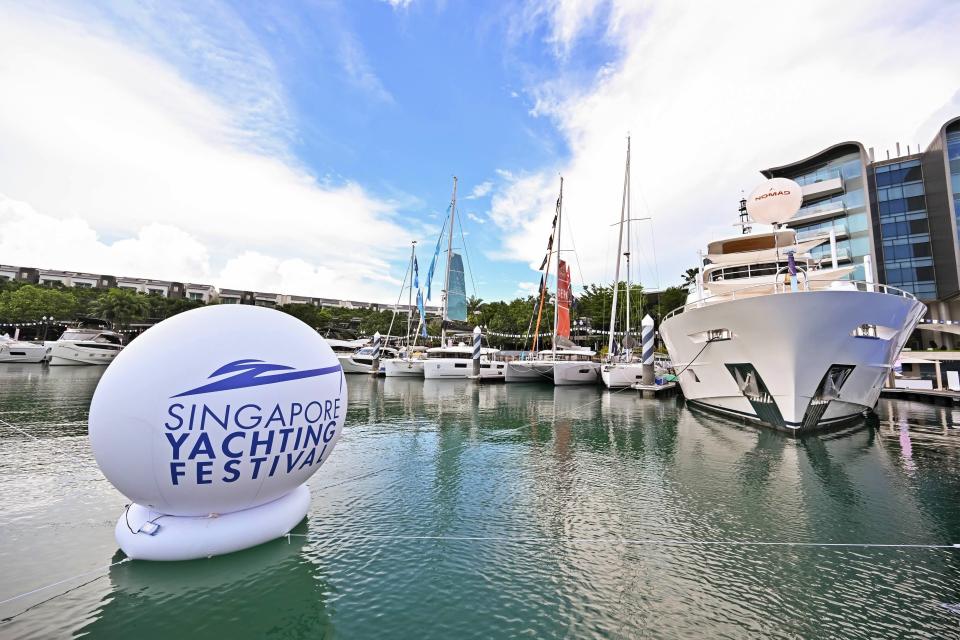
I'm on board at the Singapore Yacht Festival in late April, and sitting across from me is the man who – more than anyone else – is responsible for the fact that a UAE shipyard is now showing its flagship explorer yacht in Southeast Asia and being taken completely seriously. Erwin Bamps is Belgian, soft-spoken, and laughs easily. He has been in the marine industry long enough to have strong opinions about almost everything and generous enough to share them without pretence.
He has also, in a rather elegant move, come full circle. After 17 years building Gulf Craft from a 220-person operation into a globally recognised top superyacht builder, he left in 2018 to lead Prestige Yachts under Groupe Beneteau. In April 2025, he returned. Same company, same chairman, completely different challenge.
The man who left – and came back
There is something Bamps wants you to understand about the Middle East before anything else. It is not, he insists, a trading post.
"You can hardly think of any export from the UAE," he says. "People think it's a tourism destination. It is a place where everybody meets everybody because it's just in a good spot between Singapore and Europe. But what the chairman was trying to prove is that it is more than that – that there is ingenuity, there is engineering skill, there is a workforce that is able to produce."
It was the chairman's proposition that first brought Bamps to the UAE in the early 2000s. He was being asked to manage a manufacturing operation and, in Bamps' words, "wave the UAE flag – proudly made in the UAE." He found the idea appealing. Then came the next part of the brief: the chairman also wanted to start building superyachts. Bamps pauses at the memory.
"I thought: manufacturing is one thing. Superyachts – that's a whole different ball game. That's technology, top-quality finish, and you're selling to the most discerning clients in the world. Very picky about branding. Very picky about touches, finishes, attention to detail – not only in the product but also in the services."
He spent 17 years making it work. The company grew. The reputation grew. Gulf Craft began showing in Cannes, in Monaco, in Fort Lauderdale. And then Bamps moved on to Europe – to Prestige, to a world of semi-production boatbuilding at industrial scale, where efficiency is the metric and customisation is the exception. It was, he says, "a lot" – and the engineer in him loved it – but the contrast clarified something essential.
The return, when it came in 2025, was a choice made with open eyes. "I kept in touch with the chairman," he says simply. "We kept meeting each other at boat shows. And in 2024 we spoke about the potential to return – to take up the same seat but with a very different challenge. "The challenge now is scaling: not building a reputation from scratch, but accelerating what already exists. In record time since returning, Gulf Craft has signed 11 or 12 new global partnership deals. Bamps uses his know-how and relationships to move faster than the company might have otherwise. "I've signed up as a contributor to something I helped create," he says. "That's a huge opportunity. Part two for me. Chapter five in the company’s history."
Why you – yes, you – might actually want to be on a boat
Here is a confession Erwin Bamps makes freely: he didn't grow up around boats. He learnt to swim at thirty. Hates fishing – "too boring for me." Was not, by any conventional measure, a natural fit for running a boating company.
"When I was working in manufacturing," he says, "people would take very rational decisions, calculating how much cent that would make of the dollar. Now, yachting is a business where people say: I love the colour. Where can I sign? Don't you want to see the engine? No, I don't care."
He laughs. “It’s about emotions."
It's a line worth sitting with, because it gets at something real about how the marine industry often fails to communicate its own value. The conventional pitch – snorkelling, fishing, getting to that otherwise inaccessible beach – is true but incomplete, Bamps argues. It's the rational case. The real case is something else entirely.
"The real reason I fell in love with this industry is that it invites people to switch off." He tells it through the lens of his own family. "When my kids go boating with us, I have only one condition: they leave their iPads at home. And suddenly we realise that they can speak. They actually have stories to tell. They have opinions. You have family time."
For the high-achiever living in Singapore or Dubai – someone whose life is stacked with obligation, noise, and people – the proposition is simple and almost radical: this is one of the few environments left where the usual escape hatches don't exist. You cannot be somewhere else. "You wake up in the morning and you're the only one in the bay. There is only the sound of birds, waves. Suddenly you are bonding."
The use cases, he explains, are broader than most people realise. In Singapore especially, the boat functions as a kind of private third space – and I really love this concept! - neither office nor home. "If you want to negotiate an employment contract, have a business discussion – you want something comfortable, a bit more professional than your private home, warmer than a cold office. The upper deck of a yacht is a perfect platform." He pauses. "And we found that a lot of the other conversations – the snorkelling, the deep-sea diving – are honestly less relevant. People come to it because they want what they can't find on land: something not too noisy, not too busy, not too crowded, not too impersonal."
He tells me about a gentleman he met at this very Singapore show. The man had never considered a yacht. Bamps asked him: do you have family? Do you have enough time with them? The answer, as it always is in Singapore, was: never enough. "Then maybe," Bamps said, "this is the way to do it."
The boat and the buyer: a portrait
When I ask Bamps who, specifically, the Nomad 101 was designed for, he starts with a provocation. Think about buying a car, he says. You walk into a showroom. Fifteen, twenty manufacturers. Not a bad car among them. So how do you choose? His wife says she wants an SUV - high seating, safe, maybe some off-road capability. That eliminates several manufacturers immediately. Then she says no dark interiors. More eliminated. "So many people come and try to select the manufacturer based on some basic requirements for what they want to get into."
The Nomad buyer, in Bamps' telling, is not someone chasing Antarctic exploration on a small boat. They are not chasing Italian heritage branding. They are someone who arrives in Dubai and checks into a five-star hotel with specific expectations – a level of luxury, of hospitality, of detail and of service – that differs from what you'd find in London or Tokyo. "You want to see marble. You want a dining experience second to none. You're expecting a level of service even higher than anywhere else in the world"
That expectation, translated into a yacht, becomes the Nomad 101's design brief. During their Singapore show appearance, Gulf Craft treated us to dates and in other shows, that was paired with Arabic coffee on board – not as a gimmick but as an expression of identity. "It's part of who we are," Bamps says. "We lean into that." The interiors use earthy materials, warm wood, stone, soft openness – the aesthetic language of an Emirati palace. On the Majesty 100, a Dutch designer brought structure and rigour; Gulf Craft brought the gold rim running through an ivory interior, the recognition of a particular kind of warmth.
What Bamps is most emphatic about, though, is something beyond the product. Gulf Craft invites every client to visit the shipyard. The chairman walks the floor in traditional attire. The team gathers. People ask for photographs. Bamps himself runs down from meetings to shake hands with whoever has come. "Most of the time, when clients sit down with friends after visiting us," he says, "what they tell is not the story of the boat. It's the story of the shipyard, the people, the experience. That is something very much wanted."
It is, in other words, Arabian hospitality applied to superyacht manufacturing. He once stopped during a walk near a small oasis village in the desert and was offered water by a local who didn't share his language. "It is a natural hospitality that is still known to people," he says. "And this is one aspect that is not just about the gold rim."
Craftsmen, not assemblers
Gulf Craft grew from 220 people to nearly 2,000. Ask Bamps what culture makes that possible and he answers without hesitation: "I always hire for attitude, not for skill."
Building a superyacht, he argues, is somewhere between art and industry. "The door has to be aligned. Perfectly vertical – in this there is no compromise." Bamps describes Gulf Craft as a vertically integrated organisation – not by design but by necessity. When he arrived in 2002, there were no superyacht interior subcontractors nearby. No marble workers for the industry. No stainless steel specialists. "We had to become them." Today, nearly everything you see on board – the marble tables, the furniture, many of the sliding doors – is made in-house. Gulf Craft is, effectively, 20 companies in one.
The people Bamps looks for are not employees so much as artisans. "Small groups of experts who have their own expertise within the company." He describes walking into the marble section and having someone rush up to show him something they just finished – not because it was their job, but because they were proud. "Quality is defined by the artisan, the person doing the actual piece. The only thing I can do is raise the bar. Whether we reach it is in their hands."
He compares it to a small cheesemaker in Italy or France – the pride in workmanship, the personal investment in the thing produced. "We are not really manufacturing. We are somewhere between art and industry. Craftsmanship."
On the future of ownership – and why he doesn't own a boat
Another confession: for all his decades in the industry, Erwin Bamps doesn't own a yacht – shocking! I know. He is enthusiastic about this fact.
"I've been in boating for 28 years, and I don't have a license. I don't need to drive the boat to enjoy it. When I want to be on a boat, I want the experience. I want someone to cut the pineapple for me." He grins. "You go to a restaurant – you don't insist on doing the dishes."
His view on the ownership question is characteristically expansive: he doesn't think fractional models and traditional ownership are in competition. Both will grow. "More infrastructure pulls more boats in. More marinas, more access – the cars come when you build the highway." New boat owners will arrive who define the experience on their own terms, without the inherited assumptions of previous generations. Some will charter forever. Some will charter until they know exactly what they want and then customise. "The customer today is much better educated – not thanks to TikTok, but because they've had multiple charter experiences. They've made up their mind."
For Bamps, the more interesting shift is in what people actually want from ownership once they get there: not a badge, but hassle-free quality of life. Gulf Craft is building out owner management programmes – maintenance, crew, the full 360 – to deliver exactly that. "We are a manufacturing company, not a boat management company," he says. "But together with partners, we try to do what we cannot do personally."
He circles back to the car analogy one more time, warmly. What made him choose the Genesis over the German car wasn't the engineering. It was the service team that came to his apartment, took the car for servicing, and returned the keys before Saturday morning was over. No time wasted. "That was the decision-making factor. Not the colour." He spreads his hands. "And so when you see that today – Chinese manufacturers arriving with a million-kilometre warranty and the Germans scratching their heads – people are open for different things than they were before."
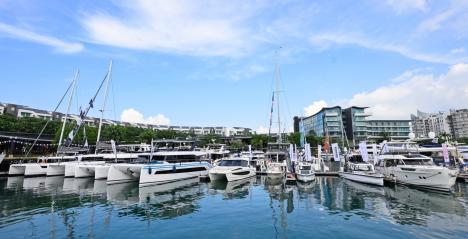
The Singapore Yacht Festival was just opening. Soon, the Nomad 101 would have moved on – to the next show, the next conversation, the next person standing on deck who didn't think they were a yacht person and finds themselves reconsidering. Bamps watches the marina with the expression of someone who has been building toward this moment for a long time and is still, somehow, finding it interesting.
I ask him what he wants that person to feel, the one standing here in their imagination for the first time. He doesn't reach for something polished. He says, 'Possibility'. And then, with a smile, he adds what he told that man at the Singapore show – the one who said he never had enough time with his family.
"Then maybe this is the way to do it."
Gulf Craft's Nomad range is available for enquiries through Gulf Craft's regional partners. For more information, visit gulfcraftgroup.com. Nina Santana is a Singapore-based contributor to Expat Choice covering people, place, and the lives worth living.